

If you’ve ever felt your heart hammering before a presentation, your voice going thin, your mind suddenly blank on words, you’re not alone. Public speaking nerves are physical in nature, and unpredictably common. The moment you step up to present, your body can flip into full threat-response mode, even when you’re fully prepared and the room feels completely neutral. That’s why people go looking for help.
In this regard, GABA and L-theanine have recently attracted attention as non-drowsy options for gently easing tension before and during performance. This article explains it honestly: what GABA actually is, what the science says and what it doesn’t say, and how Neuro Calm & Clarity Mints integrate into a practical, evidence-informed pre-presentation routine.
Why Presentations Trigger So Much Physical Response
Glossophobia- Why Public Speaking Fear Is So Common
Glossophobia is the fear of public speaking, which unswervingly ranks among the most reported anxieties. Glossophobia relates to what the brain does when emotional pressure is on, rather than a lack of confidence in one’s ability to present.
When you’re about to present, the sympathetic nervous system is automatically triggered. Cortisol and adrenaline surge. Your heart races, breathing gets shallow, your mouth goes dry, and your voice can tremble.
It is the same ‘fight-or-flight’ cascade, which the body activates for real threats. This cascade cannot distinguish between whether it’s an actual threat or merely perceived one, temporarily narrowing situational awareness, even if it’s just a presentation.
Performance anxiety in this context is not the same as a clinical anxiety disorder. It’s a commonly experienced, manageable response to a high-stakes moment. Here, what reliably works as follows: preparation, practice, and nervous system support.
If your anxiety is persistent, severe, or interfering with your career or daily life, please consult a healthcare provider. This article is not medical advice.
What GABA Actually Is (And the Honest Limits of the Research)
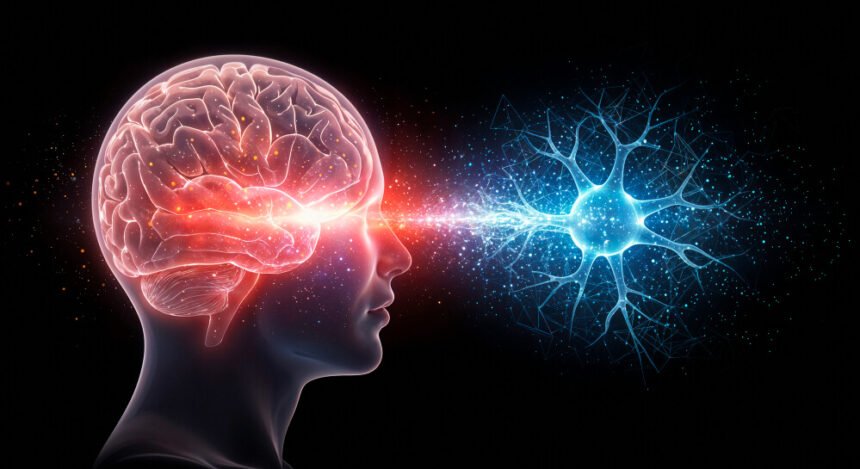
GABA, short for gamma-aminobutyric acid, is the brain’s main inhibitory neurotransmitter. Its task is to slow things down, reduce neural excitability, and help the nervous system regulate down the stress response.
Nemeroff (2003) outlined that disruptions to GABA signaling are closely linked to anxiety, and it is exactly why prescription anxiolytics like benzodiazepines work by enhancing GABA activity at the receptor level.
GABA’s Blood-Brain Barrier Debate
To be explicit here, oral GABA supplements aren’t the same as drugs that act on GABA receptors. Whether GABA taken by mouth can cross the blood-brain barrier and impact brain activity is still debated.
Byun et al. (2018) found only limited evidence supporting oral GABA’s effects on stress, and very limited evidence for sleep benefits. The authors took a cautious approach, as rigorous human trials are few, and much of the positive subjective reporting comes from consumer groups rather than controlled research settings.
More recently, Xu et al. (2025) suggested long-term GABA supplementation may modulate anxiety via complement and neuroinflammatory pathways, which is a novel mechanism that doesn’t rely on the blood-brain barrier debate. It’s early-stage evidence, but it opens a different line of inquiry.
To note, GABA supplementation isn’t well-proven in the way prescription medications are. However, that doesn’t make it meaningless; instead simply comes down to realistic expectations.
L-Theanine’s Calmer Evidence Base
L-Theanine vs. GABA- What the Research Actually Shows for Calm
L-theanine is an amino acid, naturally occurring in tea leaves, and notably backed by a stronger research base for acute stress than GABA.
Hidese et al. (2019) found that L-theanine was associated with reductions in stress and performance anxiety symptoms under acute stress conditions, which is a relevant finding.
The distinctive feature of L-theanine is its effect on alpha waves because the brain frequency is related to a relaxed-alert mental state. Based on a report by the Alzheimer’s Drug Discovery Foundation (ADDF, 2025), L-theanine’s reputation originates from its ability to produce natural calming with no sedation.
Before or during presentation, ‘natural calming’ matters since feeling drowsy and sedated when you walk into a boardroom is not exactly what most professionals are looking for. Thus, L-theanine is an option for achieving an “alert calm” state, which may keep you present and functional rather than foggy.
In Neuro Calm & Clarity Mints, GABA and L-theanine work together. They address calm through diverse projected pathways, supporting the logic of the combination formula.
What Neuro Calm & Clarity Mints Actually Contain
Neuro Calm & Clarity Mints are specifically the stress/calm SKU. They shouldn’t be confused with the Neuro Energy & Focus Gum, which contains caffeine and is formulated for alertness; while these mints are for calmness.
According to the verified product information from the Amazon listings B09S84MNT3, B08F6PCHK4, and B08F6B1F2D, what Neuro Calm & Clarity products contains as following:
- GABA-130 mg per serving
- L-theanine
- Vitamin D3
- Sugar-free (sweetened with sorbitol and xylitol)
- Gluten-free
- Aspartame-free
- Non-drowsy formulation
- Honey Lemon flavor
- Available in 72,144, and 180 piece formats
Vitamin D3 — The Supporting Cast Member
Vitamin D3 may receive less attention than GABA or L-theanine, but it serves a purpose in the formula.
According to the Mayo Clinic (2025), vitamin D3 deficiency has been associated with mood symptoms in some populations, and D3 supplementation may support mood in those who are deficient.
The evidence is mixed for people who aren’t vitamin D3 deficient. But given that vitamin D3 deficiency is common across the US, particularly in northern latitudes and during winter months, many people walk around low without knowing it.
One Neuro Calm & Clarity Mint include vitamin D3. Please check the current product label for exact dosage at the time of purchase.
A Pre-Presentation Toolkit (Evidence-Based)
While supplements can be helpful for easing presentation stress, the broader context matters as well.
Preparation (days before):
- Practice out loud at least 5–10 times because silent rehearsal doesn’t activate the same neural pathways.
- Record yourself to catch filler words and pace issues.
- Sleep 7–9 hours the night before to avoid sleep deprivation, which amplifies presentation anxiety responses.
Day of (hours before):
- Eat a balanced breakfast, and avoid a heavy carb load.
- Hydrate little by little, throughout the day.
- Limit caffeine if you get shaky or anxious at higher caffeine doses.
30–60 minutes before (this is where Calm & Clarity Mints fit):
- Take one Neuro Calm & Clarity Mint for the GABA + L-theanine + Vitamin D3 combination. Huberman Lab (2021) also recommends a dose of 100-400mg Theanine, or 3-4 nights per week, 2g of Glycine + 100mg GABA (30-60 min before bed).
- Try box breathing (4-4-4-4 counts), or the physiological sigh—a double inhale through the nose followed by a long exhale. Balban et al. (2023) found that cyclic sighing produced the greatest positive effect on mood among the breathing techniques studied.
- Practice mental rehearsal. Walk through the first 30 seconds in your mind.
- Adopt a power posing, despite its controversial evidence base, some people find it useful.
Walking in:
- Use a slow exhale (longer than your inhale) to engage the parasympathetic nervous system.
- Anchor your attention: notice a friendly face, the room layout, your notes.
During:
- Pause, instead of filling silence with “um.”
- Speak slightly slower than your nervous system wants to.
- Remember: the audience wants you to succeed.
What This Is NOT
Neuro Calm & Clarity Mints are a dietary supplement for everyday stress support. They are NOT a substitute for:
- Treatment of clinical anxiety disorders
- Prescription medication (Never replace or combine with prescriptions without consulting your healthcare provider.)
- Adequate preparation for presentation
- Sleep
If you experience severe presentation anxiety, interfering with career or life, please consult a therapist specializing in cognitive behavioral therapy (CBT) or exposure therapy, due to their strong evidence bases for performance anxiety. A therapist who specializes in this area is a better resource than any supplement.
Safety and Interactions
A few things worth knowing before you start:
- GABA supplements may theoretically interact with prescription anxiolytics, alcohol, and sedatives. Please consult your healthcare provider if you’re on any of these.
- L-theanine has a well-established safety profile in healthy adults at typical supplement doses.
- Vitamin D3 at high long-term doses can cause hypercalcemia. Therefore, stay within recommended ranges.
- If you’re pregnant, breastfeeding, or considering this for a child, consult your health care provider first.
As with any supplement, individual responses vary. These mints are formulated for healthy adults as part of a broader wellness routine.
*These statements have not been evaluated by the Food and Drug Administration. This product is not intended to diagnose, treat, cure, or prevent any disease. This article is for informational purposes only and does not constitute medical advice. Consult a qualified healthcare provider before starting any supplement, particularly if you are pregnant, breastfeeding, taking prescription medications, or have a diagnosed health condition.
FAQs
Will Calm & Clarity Mints make me sleepy during my presentation?
No. Neuro Calm & Clarity Mints are non-drowsy, and L-theanine in research supports “calm alertness” without sedation. Individual responses vary, but the formulation is designed to keep you present rather than foggy.
How is this different from prescription anti-anxiety medication?
Very different. Prescription anxiolytics (e.g., benzodiazepines, beta-blockers) target specific receptors and require medical supervision, whereas Neuro Calm & Clarity Mints are a dietary supplement (GABA + L-theanine + Vitamin D3) used as-needed for everyday stress support. They are not interchangeable, so you should never substitute one for the other without medical guidance.
Are Calm & Clarity Mints Medication?
No. Neuro Calm & Clarity Mints are a dietary supplement; not a prescription, not a drug. Calm & Clarity Mints combine GABA, L-theanine, and Vitamin D3 to support everyday calm. Prescription anti-anxiety medications work through entirely different mechanisms and require medical supervision. These are not interchangeable. Thus, never substitute a supplement for a prescription medication without guidance from your healthcare provider.
Does oral GABA actually work?
The research is mixed. A systematic review by Hepsomali et al. (2020) found limited evidence for oral GABA’s stress effects, and the blood-brain barrier question is still unresolved. Xu et al (2025) suggests novel mechanisms via neuroinflammatory pathways. Subjective user reports are from mixed to positive overall.
Can I take this before every presentation?
Supplements aren’t designed for high-frequency daily dependence. If you’re reaching for them constantly, that’s worth reflecting on — it may be a signal to address the root cause through preparation habits, coaching, or a conversation with a healthcare provider.
What’s the difference between Calm & Clarity Mints and Neuro Energy & Focus Gum?
They’re formulated for opposite use cases. Both are caffeine-free. However, Calm & Clarity Mints (GABA + L-theanine + Vitamin D3) are for calm; while Memory & Focus Gum (Cereboost® + L-theanine + B-vitamins) is for sharpness.