



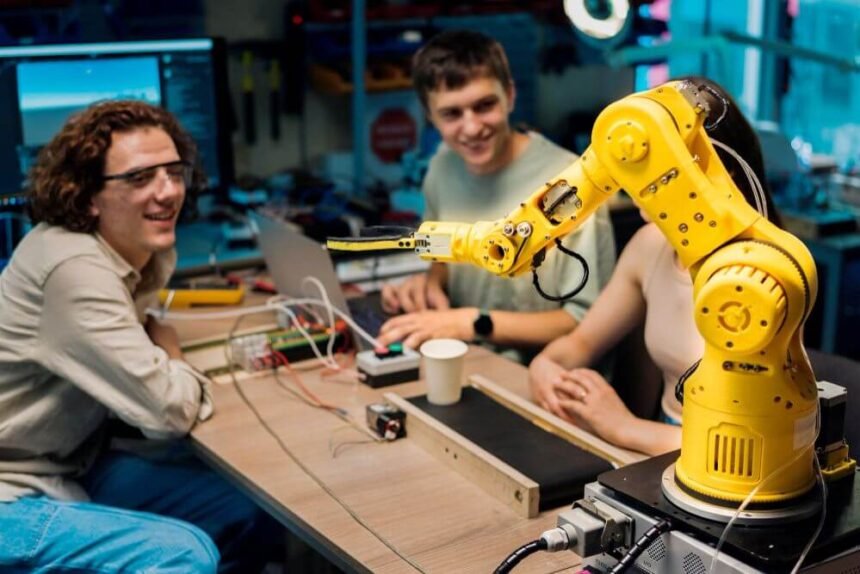
For decades, industrial robots were largely seen as the sole preserve of major manufacturers with enormous production lines and equally enormous budgets. Today, however, collaborative robots are making automation a more realistic prospect for smaller businesses too.
Designed to work alongside human operators in appropriately engineered applications, these machines, commonly called “cobots,” offer manufacturers new ways to increase productivity without completely redesigning their operations.
However, investing in cobots isn’t simply about embracing the latest technology. It’s about identifying where automation makes genuine commercial sense.
Why Collaborative Robots Are Such an Attractive Route into Automation
Traditional industrial robots excel at high-speed, high-volume production, often operating within protective enclosures. Cobots, meanwhile, are designed with collaborative operation in mind and can offer greater flexibility for manufacturers handling smaller production runs.
Many feature intuitive programming interfaces, making them easier to configure and adapt to different tasks. That flexibility can be particularly valuable for businesses producing multiple product variations or frequently changing their manufacturing processes.
However, conventional robots remain preferable for many high-speed or heavy-payload applications. Cobots are another option rather than a universal replacement.
Finding Applications That Deliver Business Value
Before purchasing a cobot, manufacturers should examine which activities consume the most time and resources. Repetitive tasks such as machine tending, assembly, palletizing, welding, and material handling can be promising candidates for automation, which more creative and demanding tasks should be left to human hands.
Consider a small manufacturer whose skilled employees spend several hours loading and unloading CNC machines. A cobot could potentially handle that repetitive activity, allowing employees to concentrate on inspection, programming, and more complex work.
The strongest opportunities usually involve predictable tasks with measurable benefits. However, businesses should also consider whether products, fixtures, and production requirements change frequently enough to complicate automation.
Building the Financial Case Beyond the Purchase Price
The robot itself is only part of the investment. A complete installation might require grippers, specialist tooling, fixtures, sensors, safety systems, programming, and employee training. Additional industrial controls for manufacturing automation and robotic systems may also be necessary to connect the cobot with existing machinery and production processes.
These expenses should form part of the total installed cost rather than appearing as unexpected additions later. Manufacturers can then compare that investment against potential improvements in production capacity, labor utilization, product consistency, and reduced downtime.
Calculating return on investment also means accounting for maintenance, ongoing support, and the time required to change between different production tasks.
Collaboration Doesn’t Remove the Need for Safety Engineering
One common misconception is that collaborative robots are automatically safe because they’re designed to operate near people. In reality, safety depends on the complete application, including the robot’s speed, payload, end effector, workpiece, and surrounding equipment. Manufacturers therefore need appropriate risk assessments and safeguards before deployment.
Ultimately, the strongest business case for cobots isn’t built around replacing people with machines. It’s about finding opportunities where people and automation can work more effectively together, creating a manufacturing operation that’s more productive, adaptable, and commercially competitive.