



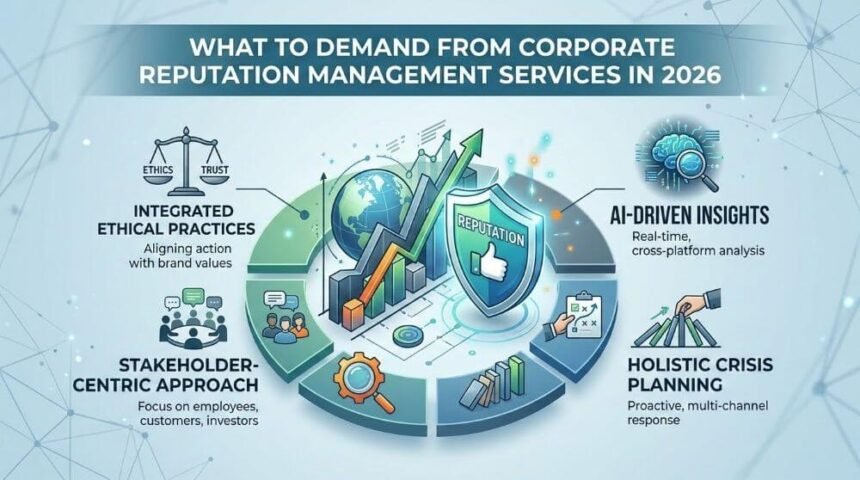
Corporate reputation threats move faster than most internal teams can respond. A single product failure, executive misstep, or social media pile-on can erase years of brand equity within hours. Corporate reputation management services have evolved to keep pace, but not all platforms are built the same way. This breakdown examines what the best services offer in 2026 and what your organization should expect.
AI-Driven Reputation Monitoring Has Become the Baseline
Platforms like Brandwatch, Meltwater, and Sprinklr now track 50,000 or more mentions across 30 or more languages within 60 seconds of publication. Organizations that switch from manual spreadsheet tracking to automated systems report an 85 percent reduction in monitoring time. That time goes back to the response strategy rather than the data collection.
Pricing ranges widely. Brandwatch costs $800 per month and includes deep social analytics and influencer mapping. Meltwater starts at $1,200 per month with broader media and stakeholder coverage. Mention offers basic alerting for $29 per month, which suits smaller operations.
When Nike’s team received a Brandwatch alert flagging 2,400 negative tweets within four minutes of a product launch, they were able to adjust messaging before the narrative spread. That kind of speed is now standard at the enterprise level.
Real-Time Sentiment Tracking: What the Methods Actually Mean
Sentiment tracking classifies mentions as positive, negative, or neutral using natural language processing models trained on tens of millions of branded data points. Four primary methods are in active use:
- Lexicon-based analysis using VADER scoring on a scale from negative one to positive one
- Machine learning via BERT models fine-tuned on social data, reaching up to 92 percent accuracy
- Aspect-based detection that separates product feature comments from overall brand perception
- Emotion detection that identifies anger, fear, and joy signals within the same mention
Sprinklr uses BERT for its sentiment engine. Brandwatch runs custom VADER hybrids adapted to industry-specific language. Both outperform free tools in complex or fast-moving brand situations. TextBlob delivers quick results but struggles with sarcasm and nuance. During a high-stakes product launch, that accuracy gap matters.
Predictive Risk Detection: The Shift From Reactive to Early Warning
Predictive risk detection is the ability to forecast reputation crises before they become public. Using 90-day sentiment velocity patterns, platforms such as Brandwatch’s Consumer Research module can flag emerging threats 10 to 14 days before they escalate with 78 percent accuracy.
Three indicators signal an emerging threat:
- Sentiment velocity: negative mentions shift more than 40 percent within 48 hours
- Influencer amplification: accounts with more than 100,000 followers engage with a specific topic
- Cross-platform spread: the same negative narrative appears on three or more platforms within six hours
Boeing identified safety concerns about the 737 MAX 11 days before mainstream media coverage, using Talkwalker’s predictive capabilities. That window allowed response teams to gather data and prepare statements before public pressure mounted.
What Proactive Crisis Management Actually Requires
Proactive crisis management combines scenario simulations with pre-approved response templates. The practical result: average response time drops from six hours to 45 minutes during a live incident.
The most functional platforms maintain libraries of approved messaging organized by risk category. These templates let teams act quickly without breaking legal, compliance, or brand guidelines. Clear escalation paths eliminate the confusion that typically slows response when pressure is highest.
A comparison of available platforms shows real differences in capability and cost:
| Platform | Annual Price | Best For | Key Limitation |
| OnSolve | $15,000 | Enterprise, multi-channel response | Complex setup |
| RepTrak Crisis | $8,500 | Mid-market, stakeholder segmentation | Limited customization |
| CoVerified | $3,200 | SMBs, Slack integration | Basic analytics |
United Airlines used OnSolve to coordinate a 12-person response team across four time zones during a 2023 weather event. The platform pushed simultaneous updates to passengers, crew, and regulatory contacts without communication gaps.
Scenario Planning and Simulation Frameworks
Crisis simulations should run 12 to 15 distinct scenarios per quarter, using AI-generated stakeholder reactions drawn from 5 years of historical crisis data. Regular drills build the kind of response instinct that holds up under real pressure.
Structured scenario categories include:
- Product recall: Three-phase response spanning 48 hours, requiring quality assurance leads, legal counsel, and public relations coordinators with pre-drafted statements at each phase
- Executive misconduct: Stakeholder mapping across 15 distinct groups, with separate communication tracks for investors, employees, customers, and media
- Data breach: Regulatory notification within 72 hours, coordinated across information security, legal, and customer support, following the Equifax 2017 framework
- Supply chain failure: Supplier communication cascades across procurement, operations, and vendor managers
- Social media backlash: Pre-approved messaging with influencer engagement strategies built in, based on the Nike Kaepernick variant
Monthly tabletop exercises alongside quarterly full drills keep response skills sharp without overwhelming internal teams.
Rapid Response Protocols: Five Escalation Levels With Clear Ownership
Rapid response protocols define five escalation levels, each with designated decision-makers and time-bound messaging windows:
- Level 1: 15 minutes
- Level 2: 45 minutes
- Level 3: 2 hours
- Level 4: 6 hours
- Level 5: 24 hours
The response sequence starts when Brandwatch alerts trigger within 60 seconds and auto-tag severity. Community managers assess the issue within 10 minutes using a five-point severity rubric. PagerDuty sends escalation notices to crisis leads. Response drafting pulls from pre-approved templates stored in shared folders.
For Level 3 incidents and above, approval requires sign-off from the manager, director, or VP before any public statement goes out. After the initial response, a 72-hour monitoring period continues to track sentiment recovery.
Wendy’s applied this protocol during a 2023 incident and delivered a public statement within 23 minutes of the first tweet.
Transparent Reporting and the Six Reputation KPIs That Matter
Transparent reporting consolidates metrics from multiple data sources into weekly executive dashboards. Effective reputation management in 2026 requires six core KPIs with documented calculation methods:
- Brand Sentiment Score: Weighted inputs from social, news, reviews, and forums
- Share of Voice: Company mentions measured against the top three competitors, normalized by total industry volume
- Trust Index: Quarterly survey scores on a 1 to 100 scale
- Response Rate: Percentage of negative mentions receiving replies within SLA timeframes
- Review Velocity: New reviews per week compared against a 13-week rolling average
- Crisis Duration: Days from first detection until sentiment returns to baseline
Dashboard construction pulls from platforms like Looker Studio, connected to Brandwatch API, Sprout Social, and SurveyMonkey. Automated refreshes every four hours keep data current for decision-makers.
How Corporate Reputation Management Services Segment Stakeholder Reporting
Custom dashboards should segment data by audience. Each group sees the metrics relevant to their decisions, not a generic overview.
- C-Suite: Overall sentiment, trust index, crisis incidents, competitive position. Tableau with hourly refresh, mobile accessible
- Marketing: Share of voice, campaign sentiment, influencer mentions, and content performance. Google Data Studio at no additional platform cost
- Operations: Review response time, complaint resolution rate, and support ticket sentiment. Klipfolio with 30-minute refresh cycles
Stakeholder Engagement: Eight Groups, Four Channels, One Coherent Strategy
Stakeholder engagement in reputation management requires mapping eight distinct groups and deploying targeted messaging through defined channels. Each group receives content at specific intervals, measured through dedicated platforms.
| Stakeholder Group | Engagement Method | Frequency | Measurement |
| Investors | Earnings calls, quarterly updates | Quarterly, with monthly updates | Diligent platform |
| Customers | Social listening, review responses, NPS | Weekly monitoring, monthly surveys | Qualtrics |
| Employees | Internal communications, engagement surveys | Bi-weekly updates, quarterly surveys | Culture Amp |
| Regulators | Compliance reports, proactive disclosure | Monthly submissions, annual reviews | NAVEX audits |
| Media | Press releases, journalist database | Event-driven with monthly outreach | Muck Rack |
| Influencers | Partnership programs, product seeding | Campaign-based with ongoing tracking | Grin dashboards |
| Communities | CSR initiatives, local partnerships | Quarterly programs | Submittable reporting |
| Partners | Joint communications, co-marketing | Monthly coordination, quarterly reviews | PartnerStack scores |
When engagement data connects directly to broader reputation intelligence systems, teams can identify perception gaps before they grow. Companies like NetReputation have written that this integration of listening and response is what separates a working reputation program from one that only shows up after a crisis.
Ethical AI and Data Governance Requirements
Ethical AI governance requires quarterly bias audits of sentiment models, documented training data sources, and human oversight for all automated decisions affecting individuals or protected groups.
Every vendor offering AI-powered reputation analytics should be able to provide full source URLs for the training data, collection dates, and percentages of demographic representation. Without that documentation, there is no way to evaluate whether the model performs equally across different audience segments.
Bias testing should use established frameworks such as IBM AI Fairness 360 and examine model performance across gender, race, and geography on a quarterly basis. Any automated scoring below 0.7 confidence when evaluating individuals should require human review before action is taken.
Data retention policies should follow clear timelines. Operational data: no more than 90 days. Aggregated metrics: up to three years. Personal identifiers: removed within 24 hours.
All sentiment vendors should undergo annual SOC 2 Type II audits. EU AI Act compliance is not optional for organizations operating in regulated markets. Reputation systems face high-risk classification by 2026, and preparation needs to start now.
How Reputation Data Connects to Business Strategy
Reputation strategy is no longer separate from business planning. At 23 Fortune 500 companies, sentiment data now feeds directly into product development roadmaps and executive compensation metrics.
Four integration points where this happens most:
- Product development: Social listening data shapes roadmap decisions weekly, with product managers accountable for how feedback influences features
- Executive performance: Trust scores from stakeholder surveys factor into quarterly compensation reviews
- Mergers and acquisitions: Deal teams require minimum reputation thresholds from third-party risk assessments before transactions proceed
- Investor relations: CFOs present brand perception and ESG risk metrics during quarterly earnings briefings
Starbucks applied this in 2024 when planning expansion across eight markets. Brand monitoring flagged local sentiment patterns that influenced site selection and community engagement approaches before any stores opened.
Measuring ROI: What the Numbers Show
Measurable ROI tracks six financial and operational metrics across 47 enterprise case studies, with average returns of 340 percent within 18 months.
The calculation framework:
- Revenue protection: Crisis incidents prevented, multiplied by an average incident revenue impact of $2.3 million
- Operational savings: Monitoring automation saves 2,400 analyst hours annually at $65 per hour, totaling $156,000
- Pricing power: Companies in the top quartile for trust scores achieve 4.2 percent higher pricing power, per the 2023 Edelman Trust Barometer
- Talent acquisition: Strong employer reputation scores correlate with 23 percent lower recruiting costs, per LinkedIn 2024 data
- Regulatory efficiency: Proactive compliance reduces audit costs by 18 percent on average in regulated industries
- Media value: Positive earned coverage is calculated at three times the advertising rates
Companies investing $150,000 or more annually in reputation management achieve 2.8 times higher trust recovery rates after a crisis.
Quarterly optimization cycles drive sustained performance. Teams review 12 KPIs, adjust three to five thresholds, and A/B test two response templates per cycle. That structured cadence is what keeps results compounding rather than plateauing.